Normalising Non-Monogamy
Perspectives 9 June 2026 · helloPOLY · 6 min read

Most people’s picture of non-monogamy is built from headlines and storylines, not from anyone they actually know. That is the strange thing about it. Non-monogamy is far more common than the silence around it suggests, and yet for a lot of people the first openly poly or open person they meet is a revelation. Normalising non-monogamy is mostly about closing that gap, between how many people quietly live this way and how rarely it gets to be ordinary.
This is a short piece on what that actually means, and why it is worth the effort.
What we mean by normalising non-monogamy
Normalising non-monogamy does not mean convincing anyone to try it. It means letting it be one unremarkable option among several, judged on the same terms as any relationship, by whether the people in it are honest, consenting and happy. Monogamy does not have to defend itself in casual conversation. The goal is simply that non-monogamy does not either.
It is worth being clear about what it is not. It is not a campaign against monogamy, which works beautifully for most people. It is not a claim that non-monogamy is more evolved or more honest. It is the quieter idea that consensual, respectful non-monogamy is a normal way for some people to love, and should be able to exist without stigma, secrecy or shame.
More common than the silence suggests
Part of why non-monogamy feels rare is that so many people keep it private, which makes it look rarer, which gives the next person another reason to stay quiet. It is a loop.
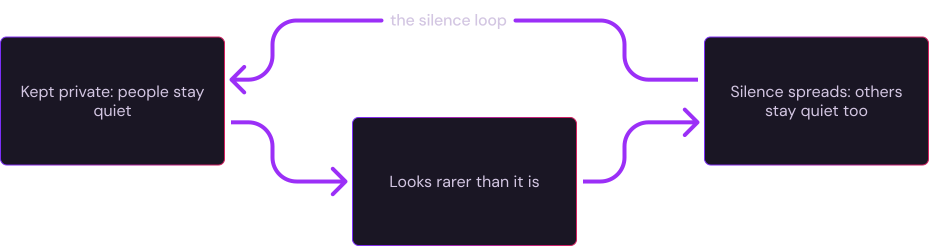
Research into consensual non-monogamy has repeatedly found that a meaningful share of people have engaged in some form of it, far more than the cultural silence would imply. The people are already here. What is missing is the everyday visibility that would let them stop explaining themselves.
What still makes it hard
The reasons people stay quiet are not paranoia. Plenty of people who are openly non-monogamous have run into real consequences, awkwardness with family, judgement at work, assumptions about what their relationships must be like. Many use pseudonyms when they talk about it publicly, or decline to use their surnames, for good reason. A relationship style that has to hide is harder to do well, because hiding adds its own strain on top of the ordinary work any relationship takes.
This is the practical case for normalising it. Stigma does not stop people being non-monogamous. It just makes them do it with less support, fewer role models and more fear.
What “normal” actually looks like up close
The reveal, when you get close to it, is how ordinary it is. Day to day, non-monogamy looks less like a fantasy and more like logistics. Shared calendars. Working out whose anniversary falls where. The same conversations about jealousy, time and feeling secure that every relationship has, just with the volume turned up because nothing can be left unsaid. People navigating it tend to be heavy communicators, not because they are unusually enlightened, but because the setup does not let them coast.
That is the version that almost never makes the headlines, and it is the one that does the most to normalise the whole thing. Not the dramatic story, but the boring one. The poly household arguing about the dishwasher. The open couple who have been solid for fifteen years. The ordinariness is the point.
Why visibility matters
Every person who lets their relationships be visible, in whatever way is safe for them, makes it a little easier for the next person. Visibility is how a thing stops being a curiosity and starts being a known quantity. It is how someone quietly wondering whether they might be polyamorous gets to see a version of it that looks liveable, rather than only the sensational one. And it is how the people around them, the friends, the families, the therapists, get enough exposure to respond with curiosity instead of alarm.
But it has to be said plainly that visibility is not equally available, and pretending otherwise does real harm. For a lot of people, being open is not a brave choice they are simply declining to make. It is a genuine risk to their job, their housing, their immigration status, their place in a faith or cultural community, or custody of their kids. Those risks do not fall evenly. They land hardest on people who are already marginalised and who have the least protection to fall back on. Telling someone in that position to just be visible is not encouragement. It is asking them to carry a cost the rest of us are not.
So this is not a call for everyone to come out. The work of normalising non-monogamy cannot rest on individuals exposing themselves one at a time, and the stigma that makes visibility risky in the first place is a systemic problem, not a personal failing. The fix sits with the culture and the institutions that punish people for how they love, in anti-discrimination protections, in workplaces, in how courts and clinics and schools treat families that do not fit the template. Those who can be visible safely can help carry the load for those who cannot. Everyone else deserves the same ordinariness without having to risk anything to get it.
Where helloPOLY comes in
This is a large part of why helloPOLY exists. A community where non-monogamy is simply the default removes the need to explain, justify or defend it, even for an evening. That ordinariness, a whole space where this is just how things are, is its own quiet form of normalising. It is somewhere people can be matter-of-fact about their lives, meet others who get it, and find the everyday version of non-monogamy rather than the headline one.
The work of normalising non-monogamy is slow, and it is mostly made of ordinary moments. A space where those moments can happen without a second thought is a good place to start.